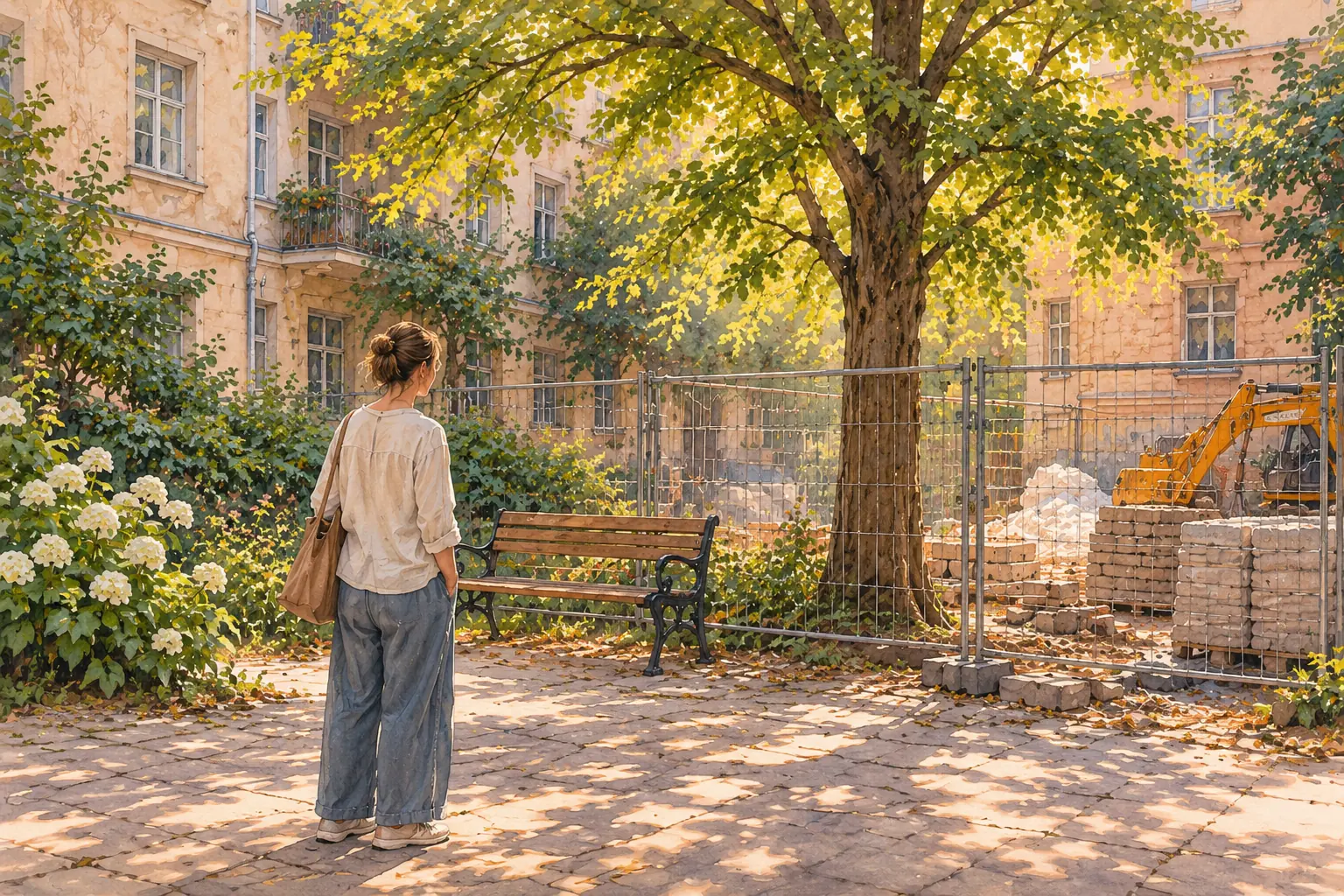
When Familiar Places Change
Why can a change in our surroundings sometimes feel larger than its physical scale would suggest? What happens when something that has quietly become part of everyday life is moved, removed, or altered? And why might the stability of the places around us matter more at some periods of life than at others?
Our surroundings are changing all the time, and we do not experience every change as a loss. A building disappears, a tree is cut down, a street is redesigned, a familiar route changes, a new structure appears where an old one stood. The meaning of each change depends partly on the role that the altered element had come to play in a person’s life.
A physical change can be small and still alter the way a place is experienced. We may barely notice a tree while it is there, yet when it is removed, its absence can change the way an entire courtyard feels. A familiar meeting point may seem unremarkable until it is no longer there. A route that has been walked thousands of times can feel strangely different when one of its landmarks changes.
Perhaps this is because a place is never only a collection of physical objects. Over time, parts of our surroundings become incorporated into the way we move through the world, remember our lives, and recognize where we are.
How the environment becomes part of our inner map
We do not experience our surroundings as photographs or detailed maps. To move through an environment, we need a more schematic understanding of where things are: which street leads somewhere, where a familiar turn is, what comes after a particular building. In psychology, this kind of internal representation is described as a cognitive map. Edward Tolman used the concept to describe how living beings develop a broader representation of spatial relationships that allows them to orient themselves in an environment rather than simply memorize a sequence of actions (Tolman, 1948).
Some elements of this internal map become more important than others. In his research on how people perceive cities, Kevin Lynch described landmarks as elements that help people recognize and organize their surroundings (Lynch, 1960). A landmark might be a tower, a bridge, an unusual building, a tree, or another distinctive object. Its significance does not necessarily depend on artistic or historical value. What matters is its ability to help a person understand where they are.
We rarely think about this consciously. We do not usually tell ourselves that a particular tree is an important element of our cognitive map. We simply become accustomed to seeing it. Someone may use it to explain where to turn. Someone else may meet a friend nearby. A child may pass it every morning on the way to school. A person may walk past it for decades on the way to work.
Repeated actions gradually connect an object with a place. The object can become so familiar that it is no longer experienced as something separate. It becomes part of how the place itself is recognized.
Something else happens at the same time. The same route may be repeated for many years while a person’s life changes completely. At one stage, someone may walk down the street on the way to work. Years later, they may walk there with a child. Decades later, they may return along the same route as an older person, perhaps after a family gathering with the next generation.
The surroundings become one of the few witnesses to these different periods of life. They do not remember us in any literal sense, but they remain physically present while our lives change around them. In this way, familiar elements of the environment can become part of our personal history as well as part of the physical landscape.
From space to place
Environmental studies distinguish between space and place. Space can be described through physical characteristics such as distances, boundaries, and the arrangement of objects. A place emerges when space acquires meaning through experience, memory, relationships, and activity (Relph, 1976; Tuan, 1977).
The difference can be seen in very ordinary situations. A courtyard may be simply an area between buildings to one person. To another, it may be the place where they grew up. A railway station may be a point of transfer for one traveler. For another, it may be the place associated with a first journey or a final meeting with someone they loved. Physically, it is the same location. Psychologically, these can be entirely different places.
Environmental psychologists use the term place attachment for the emotional, cognitive, and behavioral bond between people and particular places (Scannell & Gifford, 2010). Maria Lewicka’s review of the field shows that place attachment can emerge from many different sources, including length of residence, personal memories, social relationships, everyday activities, and a sense of belonging (Lewicka, 2011).
Attachment does not have to feel like a strong love for a place. Sometimes we discover that a place matters to us only when something changes.
A person may never have thought about how much the old courtyard meant to them until construction begins there. They may barely notice a familiar tree until it is gone. An old building may seem unremarkable until it disappears.
What disappears is not necessarily just an object. A small part of the familiar system within which a person has been living may have been disrupted.
Places and the sense of self
There is another layer to this relationship. In 1983, Harold Proshansky and his colleagues proposed the concept of place identity, describing the role that the physical environment can play in the development of a person’s sense of self, including memories, values, feelings of belonging, and understandings of one’s own life (Proshansky, Fabian, & Kaminoff, 1983).
This does not mean that a person derives their identity from a particular street, building, or square. Rather, a place can become one of the materials from which a biography is made.
When someone says, “I grew up here,” the meaning may involve much more than an administrative area or a name on a map. It may include particular streets, courtyards, schools, shops, parks, stations, and places where important things happened.
Research on autobiographical memory also points to the relationship between place and the experience of one’s own life. Knez, for example, considers place as an important component of autobiographical memory and of the relationship between people and their past (Knez, 2014).
In this sense, the environment can become a kind of external support for a human biography. We change, while some places remain. When we return to them, we may encounter not only the place as it exists today, but also some part of the life we once lived there.
This may help explain why a familiar place can carry a significance that is difficult to describe in purely physical terms. Its meaning has accumulated through experience.
What we pass on through places
There may be another reason to treat familiar places with some care. We do not pass on only stories, knowledge, photographs, and family objects. We also pass on places.
We show children where we used to play, where we went to school, where we met our friends, where important events in our lives took place. A child may not know all the stories associated with a particular location, but gradually begins to recognize it as part of the family’s geography.
A tree that was already there when a parent was a child can become part of a child’s own understanding of home. A building that has stood for decades may be familiar to several generations of the same family. A place where generations have met can acquire a continuity that no individual person could create alone.
The physical environment does not literally store human memories. But it can allow different lives to meet at the same spatial point. Perhaps this is one of the quiet functions of familiar places: they allow generations to encounter one another not only through time, but through space.
The years that become history
A place that has stood for decades can become part of the memory of several generations. For people who have known it all their lives, its present form may not feel like a particular historical arrangement at all. It may simply be the environment they grew up with.
This matters when we think about changes to familiar places. An earlier state of a place may have a longer documented history, but the decades that followed are not an empty interval between different historical periods. Those years contained lives. People grew up, met one another, raised children, changed professions, lost loved ones, celebrated important events, and returned home along the same streets. The physical environment was present through all of it.
A place that has remained for decades may therefore carry several layers of history at once: the history of its creation, the history of its changes, and the history of the people who came to know it in its present form. The passage of time can make an arrangement feel ordinary and almost invisible. Yet the very fact that it has remained familiar for so long may be part of what makes it matter to people.
Stability as a value
A stable environment is not the same as an unchanging one. A living city or neighborhood is always changing. Buildings are renovated, transportation systems change, new places appear, old ones disappear, and people adapt. Yet within this continual movement, some elements remain stable long enough to become predictable.
That may matter partly because our own lives are rarely stable. We change jobs and relationships. Children grow up. Parents age. Habits change. New responsibilities appear. Sometimes we move from one place to another.
Against this background, the physical environment can be surprisingly persistent. A house may remain for decades. A tree continues to grow. A street stays where it is. A familiar meeting place remains recognizable.
When the wider social world feels relatively predictable, a change in the environment may simply feel like one more change in the city or neighborhood. But when the social world becomes less predictable, we may value what remains unchanged more strongly.
This does not mean that a familiar object itself removes anxiety. It may be that stability becomes more noticeable when it is scarce. Something as ordinary as a house, tree, street, or familiar landmark may become part of the small amount of the world that does not require us to constantly adapt.
We cannot say how large such an effect might be, or whether it applies to particular kinds of urban objects. But the possibility seems worth noticing.
When the place changes while you remain
One concept offers another way of looking at this experience: solastalgia. Glenn Albrecht and his colleagues introduced the term to describe distress associated with negative changes in a familiar environment when a person remains in their place but the place itself changes (Albrecht et al., 2007).
Solastalgia differs from nostalgia. Nostalgia involves turning toward a past that has been lost. With solastalgia, a person remains in the familiar place and discovers that the surrounding world is no longer quite the world they knew.
Context matters here. The same physical change may pass almost unnoticed in one situation and be experienced as another loss of familiarity in another. Its significance depends not only on the size of the change but also on the history of a person’s relationship with the place.
We cannot know how strongly any particular person would experience a given environmental change. Some people may barely notice it. Others may feel that something important has shifted.
Perhaps the more useful question is not whether a change is objectively large or small, but what has become connected to the thing being changed. A tree can be shade, orientation, childhood, and a daily routine at the same time. A route can be a way of getting somewhere and also a thread connecting different periods of a life. A familiar corner of a neighborhood may seem ordinary, yet it can also be a place where important relationships have begun and grown over time.
When such an element changes, the physical environment changes first. But sometimes something in our relationship with our own past changes with it.
What remains
Places inevitably change, and people adapt to those changes. Yet when we consider a familiar environment, its physical dimensions are only part of the story. A place can hold together different kinds of time: the history of the place itself, the everyday present, and the personal histories of the people who have passed through it.
Perhaps this is why a change can sometimes feel larger than its physical dimensions suggest. We may not be responding only to the altered object. We may also be responding to a change in our internal map, to the interruption of a familiar pattern, to the loss of something that has accompanied us through different periods of life, or to the feeling that one of the stable elements of our world has become uncertain.
And perhaps this is one of the quiet human values of a familiar place: it can remain part of our lives while our lives themselves have changed many times. The place does not remember us. But it may help us remember ourselves.
References
Albrecht, G., Sartore, G.-M., Connor, L., Higginbotham, N., Freeman, S., Kelly, B., Stain, H., Tonna, A., & Pollard, G. (2007). Solastalgia: The distress caused by environmental change. Australasian Psychiatry, 15(1), S95–S98. https://doi.org/10.1080/10398560701701288
Knez, I. (2014). Place and the self: An autobiographical memory synthesis. Philosophical Psychology, 27(2), 164–192. https://doi.org/10.1080/09515089.2012.728124
Lewicka, M. (2011). Place attachment: How far have we come in the last 40 years? Journal of Environmental Psychology, 31(3), 207–230. https://doi.org/10.1016/j.jenvp.2010.10.001
Lynch, K. (1960). The Image of the City. MIT Press.
Proshansky, H. M., Fabian, A. K., & Kaminoff, R. (1983). Place-identity: Physical world socialization of the self. Journal of Environmental Psychology, 3(1), 57–83. https://doi.org/10.1016/S0272-4944(83)80021-8
Relph, E. (1976). Place and Placelessness. Pion.
Scannell, L., & Gifford, R. (2010). Defining place attachment: A tripartite organizing framework. Journal of Environmental Psychology, 30(1), 1–10. https://doi.org/10.1016/j.jenvp.2009.09.006
Tolman, E. C. (1948). Cognitive maps in rats and men. Psychological Review, 55(4), 189–208. https://doi.org/10.1037/h0061626
Tuan, Y.-F. (1977). Space and Place: The Perspective of Experience. University of Minnesota Press.
This text was developed with the assistance of AI.