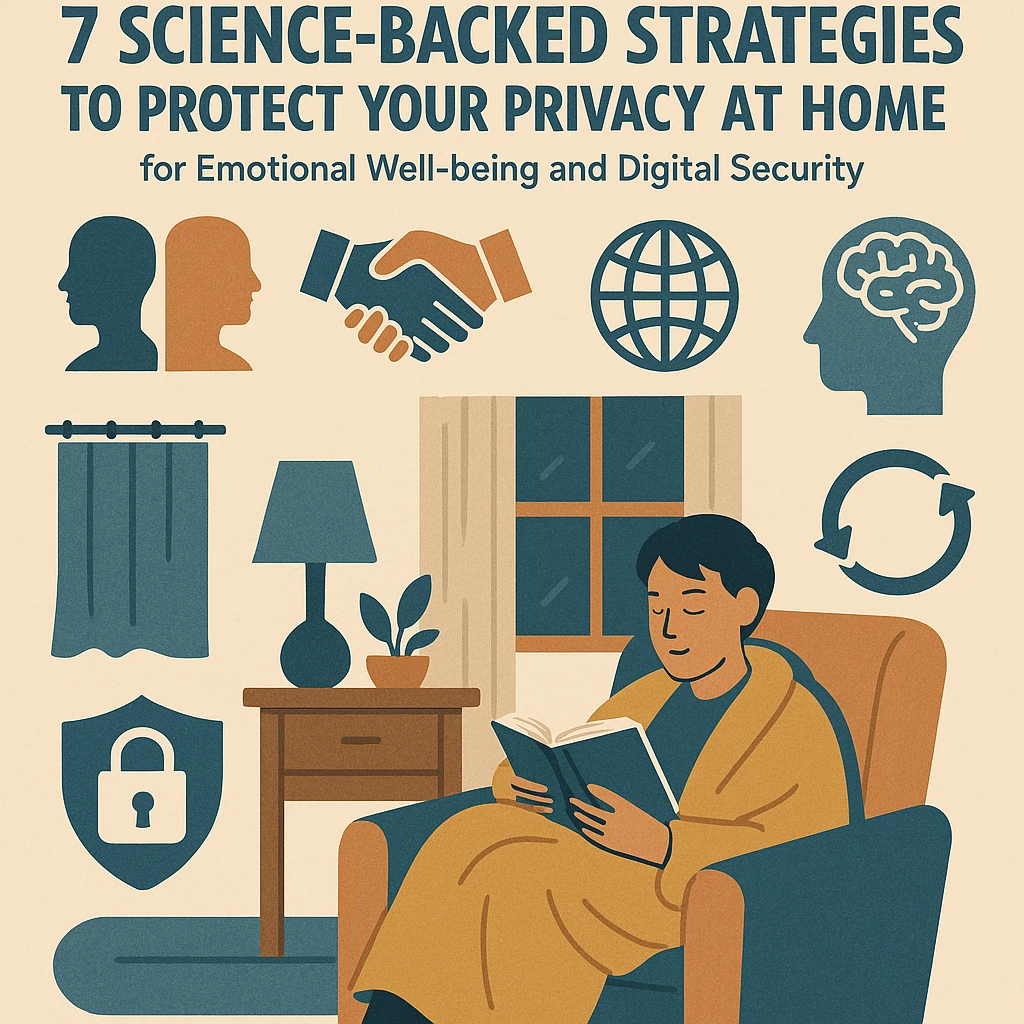
7 Science-Backed Strategies to Protect Your Privacy at Home for Emotional Well-being and Digital Security
Introduction: The Sanctuary of Home Privacy
In an era of always-on connectivity and shrinking personal space, the quest for privacy at home has never felt more urgent—or more complicated. Our homes are meant to be sanctuaries, but daily realities of shared rooms, digital intrusions, and blurred work-life boundaries mean privacy must be earned and continually nurtured. Scientific research across psychology, neuroscience, sociology, architecture, and technology is clear: fostering privacy at home isn’t just a luxury; it’s a necessity vital to your well-being, your relationships, and your sense of security.
This guide blends the latest evidence with warm, real-world advice. Let’s explore seven science-backed strategies to protect your privacy at home, each rooted in both rigorous research and the wisdom of lived experience.
1. Psychological Benefits: Sanctuary Zones for Emotional Renewal
Home is the crucible of our most intimate selves. Psychologists describe privacy at home as your ability to control access to your body, thoughts, and belongings—a profound source of emotional balance. Without genuine private spaces, people of all ages report increased stress, irritability, and a diminished sense of self.
A private nook isn’t about hiding—it’s about decompression and self-restoration. Whether it’s the ritual of reading in an armchair, unwinding in a bath, or simply sitting quietly by a window, these sanctuary zones are lifelines for mental health.
How to Build Sanctuary:
- Designate a spot—however modest—as your personal retreat. Name it, adorn it, and communicate its boundaries.
- Use consistent cues: a reading lamp, headphones, or a favorite blanket. These signal your need for solitude.
- Respect privacy for all: Normalize alone-time for each member of the household, affirming that restoration is neither selfish nor antisocial.
2. Social Boundaries: The Art of Negotiation in Shared Spaces
Privacy isn’t only about walls. Sociological research tells us that shared living thrives on social negotiation: explicit and implicit agreements over noise, access, and alone time. When these boundaries are respected, trust and harmony follow; when they crack, resentment and tension seep in.
How to Strengthen Social Privacy:
- Start honest conversations. Even a monthly “household check-in” about comfort levels, privacy expectations, and shared chores can transform the home atmosphere.
- Establish visual or auditory signals: agreed-upon signs for “do not disturb,” rules about knocking, and periods of household quiet.
- Apologize quickly and sincerely if you cross a privacy boundary. Repairing small breaches maintains lasting trust.
3. Cultural Perspectives: Honoring Differences, Creating Belonging
Anthropologists remind us: privacy is learned. Its meaning and the ways we protect it vary with culture, upbringing, and lived experience. A closed door in one family may signal solitude; in another, it may feel unfriendly. For multicultural households, negotiating these unspoken privacy norms can be a source of both friction and new empathy.
Advice for Culturally Diverse Homes:
- Invite stories. Ask each member what privacy looked like in their family growing up.
- Experiment with blended customs—like “rotating privacy” or agreed household quiet hours—to build a unique, shared culture.
- Respect even the unfamiliar: A roommate’s need for prayer time, or an elder’s wish for a private meal, are opportunities to show understanding beyond words.
4. Neuroscience: Time and Space for the Brain
Neuroscience confirms: private time is a brain necessity, not an extravagance. Downtime refreshes your attention, reduces stress hormones, and restores creative capacity. Without such moments, the mind becomes cluttered and irritable.
Apply Brain Science at Home:
- Prioritize “brain breaks.” Schedule predictable windows—ten minutes before bed, early morning quiet, a walk on your lunch break—where you can think undisturbed.
- Limit exposure to digital noise and shared spaces at least once daily.
- Encourage all household members to take—and support—periods of solitude for mental clarity and emotional recharge.
5. Home Design: Creating Space for Privacy
Architecture shapes experience. Research shows that spatial hierarchy—organizing rooms by their degree of privacy—creates psychological safety. Doors, partitions, and even clever furniture placement are powerful allies, especially in open-plan or small homes.
Design Solutions for Private Space:
- Use curtains, screens, or bookshelves to carve out semi-private zones.
- Arrange furniture to reduce direct sightlines and shared sound. Small changes, like turning a chair to face a wall, dramatically alter how private a corner feels.
- Maintain the functionality of doors, invest in locks if needed (and appropriate), and make sure everyone knows they have a right to close their own space.
6. Digital Home Privacy: Securing the Invisible Boundaries
The smart home revolution brings both convenience and risk. Internet of Things (IoT) devices, from smart speakers to connected thermostats, silently collect data with privacy implications most residents barely suspect. Digital boundaries are just as essential as physical ones.
Practical Steps for Digital Security:
- Regularly audit device privacy settings. Disable unused microphones or cameras, and update software for the latest security patches.
- Create device-sharing agreements. Set clear rules about who can access smart TVs, speakers, or household accounts.
- Cultivate digital literacy. Even children can learn about safe device use, the dangers of oversharing, and the importance of strong, unique passwords.
7. Adaptation During Change: Embracing Flexibility and Compassion
Crises like the pandemic have shown that household privacy can be quickly disrupted—and just as quickly rebuilt—through creativity and flexible routines. When bedrooms become offices, or living rooms double as gyms or classrooms, the need for adaptability is clear.
Ways to Stay Resilient:
- Rotate “private time” or “quiet space” schedules.
- Create portable retreat kits—a box with headphones, a book, or sensory comforts—to set up privacy anywhere.
- Foster a household culture where it’s safe to ask for solitude and to offer support for others’ need for space, even when resources are limited.
Science-Backed Summary Table: Privacy at Home
| Privacy Strategy | Key Scientific Finding | Practical Example |
| Psychological sanctuary zones | Private spaces restore emotional health and resilience | Personal reading nook, meditation spot |
| Social negotiation & boundaries | Clear rules prevent conflict and increase trust | Family meeting to set privacy agreements |
| Cultural sensitivity | Respect for norms builds cross-cultural harmony | Honoring roommate prayer/quiet time |
| Cognitive downtime | Predictable solitude sharpens brain function | Daily quiet hours, no-device times |
| Home design & architecture | Clear spatial hierarchy boosts privacy perception | Curtains, bookcases as dividers |
| Digital privacy | IoT devices can compromise home security | Audit device settings, update passwords |
| Flexible adaptation | Resilient routines foster shared well-being | Rotating private spaces, check-ins |
Conclusion: Make Privacy a Daily Act of Care
Science, across its disciplines, makes a compelling case: privacy at home is foundational to flourishing. Yet knowledge alone does little until it inspires deliberate action and compassion—for yourself and those you live with. Create—and defend—your own sanctuary zones. Nurture empathy in boundary-setting, welcome difference, and champion digital safety. As research and daily life both teach us, a private home is less about square footage and more about understanding, respect, and the everyday rituals that turn shelter into sanctuary.
References:
https://pmc.ncbi.nlm.nih.gov/articles/PMC8931782/
https://insights.lifemanagementsciencelabs.com/enhancing-privacy-at-home/
https://bpb-eu-w2.wpmucdn.com/blogs.bristol.ac.uk/dist/1/670/files/2023/08/Home-Alone-paper.pdf
https://www.sciencedirect.com/science/article/abs/pii/S0197397515300126
http://www.psy.vanderbilt.edu/courses/hon1850/Moore2017_Article_PrivacyNeuroscienceAndNeuro-Su.pdf
https://www.sciencedirect.com/science/article/pii/S1071581923001477
https://www.epfl.ch/labs/lasur/wp-content/uploads/2018/05/GAUVAINandALTMAN.pdf
https://engineering.nyu.edu/news/new-research-reveals-alarming-privacy-and-security-threats-smart-homes